
Best Seller Services
View All Services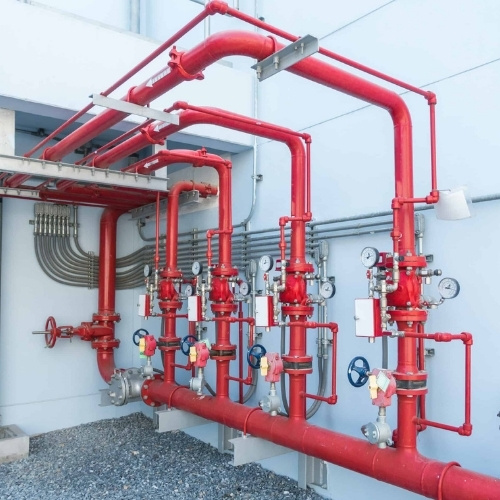
Sprinklers And Deluge Systems
Fire Check
Sprinklers And Deluge Systems
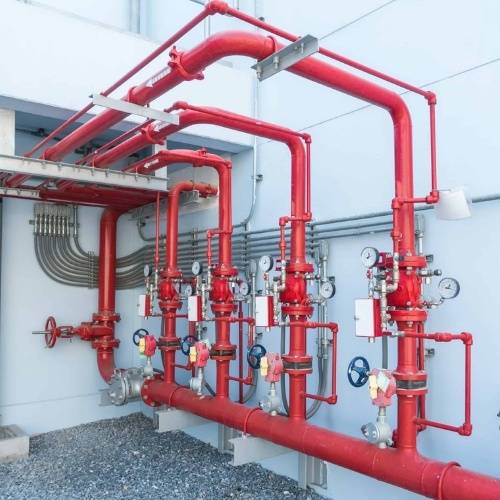
Sprinklers may be required to be installed by building codes, or may be recommended by insurance companies to reduce potential property losses or business interruption. Building codes in the United States for places of assembly, generally over 100 persons, and places with overnight sleeping accommodation such as hotels, nursing homes, dormitories, and hospitals usually require sprinklers either under local building codes, as a condition of receiving State and Federal funding or as a requirement to obtain certification (essential for institutions who wish to train medical staff.
Operation
Each closed-head sprinkler is held closed by either a heat-sensitive glass bulb or a two-part metal link held together with fusible alloy. The glass bulb or link applies pressure to a pip cap which acts as a plug which prevents water from flowing until the ambient temperature around the sprinkler reaches the design activation temperature of the individual sprinkler head. In a standard wet-pipe sprinkler system, each sprinkler activates independently when the predetermined heat level is reached. Because of this, the number of sprinklers that operate is limited to only those near the fire, thereby maximizing the available water pressure over the point of fire origin.
A sprinkler activation will do less damage than a fire department hose stream, which provide approximately 900 liters/min (250 US gallons/min). A typical sprinkler used for industrial manufacturing occupancies discharge about 75-150 litres/min (20-40 US gallons/min). However, a typical Early Suppression Fast Response (ESFR) sprinkler at a pressure of 50 psi (340 kPa) will discharge approximately 100 US gallons per minute (0.0063 m3/s). In addition, a sprinkler will usually activate between one and four minutes, whereas the fire department typically takes at least five minutes to arrive at the fire site after receiving an alarm, and an additional ten minutes to set up equipment and apply hose streams to the fire. This additional time can result in a much larger fire, requiring much more water to achieve extinguishment. Design intent Sprinkler systems are intended to either control the fire or to suppress the fire. Control mode sprinklers are intended to control the heat release rate of the fire to prevent building structure collapse, and pre-wet the surrounding combustibles to prevent fire spread. The fire is not extinguished until the burning combustibles are exhausted or manual extinguishment is effected by firefighters. Suppression mode sprinklers (formerly known as Early Suppression Fast Response (ESFR) sprinklers) are intended to result in a severe sudden reduction of the heat release rate of the fire, followed quickly by complete extinguishment, prior to manual intervention.
Fire Equipment And Safety
Fire Check
Fire Equipment And Safety
1. PURPOSE
The purpose of this Standard is to ensure
1.1. This standard sets out the company’s minimum requirements in terms of Personal Protective Equipment (PPE)
1.2. This standard is not exhaustive and operations may identify site specific PPE requirements through risk assessments and the use of a PPE need matrix.
2. SCOPE
This Standard applies to all Tongaat Hulett Operations.
3. REFERENCES
Occupational Health and Safety Act 85/1993
• General Safety Regulations – Regulation 2(3), 3(9)
• Driven Machine Regulations – regulation 20(3) (a), 8(6)
• Section 38 (1) (n) & (o)
• General Safety Regulations 2, 9 (General Health & Safety Regulation 2 & 9)
• General Safety Regulations – Regulation 2 (3) (a)
• Environmental Regulations – Regulation 2 (2) (b)
• Asbestos Regulations
SANS 809- 1984 – Industrial Safety Harnesses
SANS 1280 – Specification for Industrial Safety Belt Webbing
SANS 0400
SANS 0041 – Code of Practice for Noxious Dusts & Fumes
SANS 434, 1068 AND 136 – Protective Clothing
SANS 492 – Standard Specifications for Symbolic Safety Signs
SANS 083 – 1993. Measurement and assessment of occupational noise for hearing conservation purposes.
SANS 1451 – Part 1 & 2 - Standard Specification for Hearing Protectors, Ear Muffs & Plugs and / or applicable legislation for operations outside South Africa.
Personal protective equipment (PPE) refers to protective clothing, helmets, goggles, or other gear designed to protect the wearer's body or clothing from injury by electrical hazards, heat, chemicals, and infection, for job-related occupational safety and health purposes.
Assessing suitable PPE
- To allow the right type of PPE to be chosen, carefully consider the different hazards in the workplace. This will enable you to assess which types of PPE are suitable to protect against the hazard and for the job to be done.
- Ask your supplier for advice on the different types of PPE available and how suitable they are for different tasks. It may be necessary in a few particularly difficult cases to obtain advice from specialist sources and from the PPE manufacturer.
Consider the following when assessing whether PPE is suitable:
- Is it appropriate for the risks involved and the conditions at the place where exposure to the risk may occur? For example, eye protection designed for providing protection against agricultural pesticides will not offer adequate face protection for someone using an angle grinder to cut steel or stone.
- Does it prevent or adequately control the risks involved without increasing the overall level of risk?
- Can it be adjusted to fit the wearer correctly?
- Has the state of health of those who will be wearing it been taken into account?
- What are the needs of the job and the demands it places on the wearer? For example, the length of time the PPE needs to be worn, the physical effort required to do the job and the requirements for visibility and communication.
- If more than one item of PPE is being worn, are they compatible? For example, does a particular type of respirator make it difficult to get eye protection to fit properly.
The hazards and types of PPE:
Eyes
- Hazards: chemical or metal splash, dust, projectiles, gas and vapour, radiation.
- Options: safety spectacles, goggles, faceshields, visors.
Head
- Hazards: impact from falling or flying objects, risk of head bumping, hair entanglement.
- Options: a range of helmets and bump caps.
Breathing
- Hazards: dust, asbestos, vapour, gas, oxygen-deficient atmospheres.
- Options: disposable filtering facepiece or respirator, half- or full-face respirators, air-fed helmets, breathing apparatus.
- Protecting the body with safety protective wear
- Hazards: temperature extremes, adverse weather, chemical or metal splash, spray from pressure leaks or spray guns, impact or penetration, contaminated dust, excessive wear or entanglement of own clothing. Options: conventional or disposable overalls, boiler suits, specialist protective clothing, e.g. chain-mail aprons, high-visibility clothing.
Hands and arms
Hazards: abrasion, temperature extremes, cuts and punctures, impact, chemicals, electric shock, skin infection, disease or contamination.
Options: gloves, gauntlets, mitts, wristcuffs, armlets.
Feet and legs - safety wear
Hazards: wet, electrostatic build-up, slipping, cuts and punctures, falling objects, metal and chemical splash, abrasion.
Options: safety boots and shoes with protective toe caps and penetration-resistant mid-sole, gaiters, leggings, spats.

Integrated Security Systems
Fire Check

Integrated Security Systems
Closed-circuit television (CCTV) is the use of video cameras to transmit a signal to a specific place, on a limited set of monitors.
It differs from broadcast television in that the signal is not openly transmitted, though it may employ point to point (P2P), point to multipoint, or mesh wireless links. Though almost all video cameras fit this definition, the term is most often applied to those used for surveillance in areas that may need monitoring such as banks, casinos, airports, military installations, and convenience stores. Videotelephony is seldom called "CCTV" but the use of video in distance education, where it is an important tool, is often so called.
In industrial plants, CCTV equipment may be used to observe parts of a process from a central control room, for example when the environment is not suitable for humans. CCTV systems may operate continuously or only as required to monitor a particular event. A more advanced form of CCTV, utilizing Digital Video Recorders (DVRs), provides recording for possibly many years, with a variety of quality and performance options and extra features (such as motion-detection and email alerts). More recently, decentralized IP-based CCTV cameras, some equipped with megapixel sensors, support recording directly to network-attached storage devices, or internal flash for completely stand-alone operation.
Access control refers to exerting control over who can interact with a resource. Often but not always, this involves an authority, who does the controlling. The resource can be a given building, group of buildings, or computer-based information system. But it can also refer to a restroom stall where access is controlled by using a coin to open the door.
Access control is, in reality, an everyday phenomenon. A lock on a car door is essentially a form of access control. A PIN on an ATM system at a bank is another means of access control. The possession of access control is of prime importance when persons seek to secure important, confidential, or sensitive information and equipment.
Physical access control is a matter of who, where, and when. An access control system determines who is allowed to enter or exit, where they are allowed to exit or enter, and when they are allowed to enter or exit. Historically this was partially accomplished through keys and locks. When a door is locked only someone with a key can enter through the door depending on how the lock is configured. Mechanical locks and keys do not allow restriction of the key holder to specific times or dates. Mechanical locks and keys do not provide records of the key used on any specific door and the keys can be easily copied or transferred to an unauthorized person. When a mechanical key is lost or the key holder is no longer authorized to use the protected area, the locks must be re-keyed.
Electronic access control uses computers to solve the limitations of mechanical locks and keys. A wide range of credentials can be used to replace mechanical keys. The electronic access control system grants access based on the credential presented. When access is granted, the door is unlocked for a predetermined time and the transaction is recorded. When access is refused, the door remains locked and the attempted access is recorded. The system will also monitor the door and alarm if the door is forced open or held open too long after being unlocked.
Automatic Foam Systems
Fire Check
Automatic Foam Systems
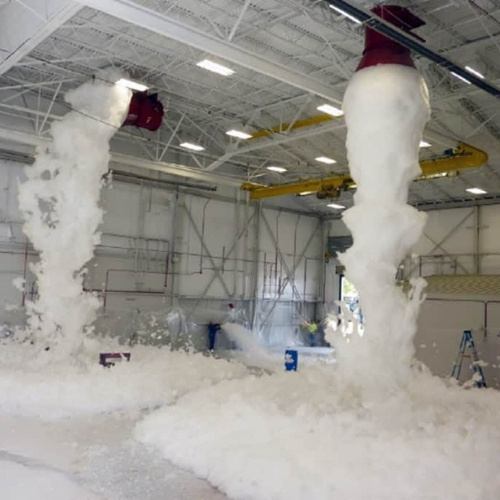
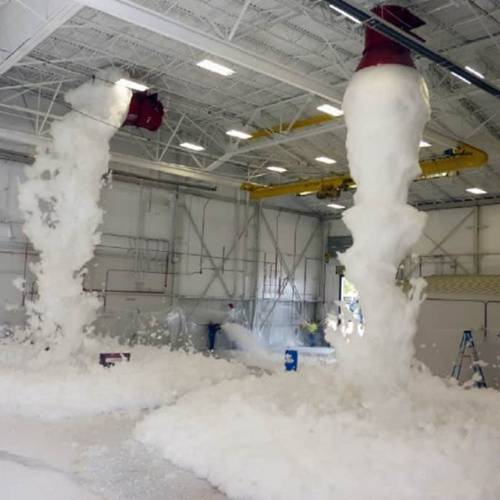
Foam systems protect virtually any hazard where flammable liquids are present. These hazards are common to a multitude of industries including Petrochemical, Chemical, Oil and Gas, Aviation, Marine/Offshore, Manufacturing, Utilities,
- Military, and Transportation.
- Flammable Liquid Storage
- Loading Racks
- Processing Areas
- Refineries
- Dike Areas
- Aircraft Hangars
- Heliports
- Jet Engine Test Facilities
- LNG Storage/Manufacturing
- Marine Applications
- Warehouses
How Foam Systems Work
Fire fighting foam systems suppress fire by separating the fuel from the air (oxygen). Depending on the type of foam system, this is done in several ways:
The following represents operation of a typical foam-water sprinkler system.
Although many other types of systems are available; a basic foam system will always require foam agent storage, proportioning equipment, one or more discharge devices, and a manual and/or automatic means of detecting the fire and actuating the system.
Fire breaks out in the rack storage area of a flammable liquid warehouse.
Rising heat from the fire ruptures the quartzoid bulb(s) in the sprinkler head(s) which starts the flow of water.
Flowing water opens the alarm check valve which allows water to open the hydraulic foam concentrate valve and operate the water-motor gong.
Foam concentrate flows from the bladder tank into the proportioner where it is mixed with the flowing water at the designed foam solution percentage.
Foam is generated as the foam solution discharges through the sprinkler head(s) onto the fire.